

Today, the 9th of May, is Europe Day. Taking place just after VE Day commemorating the Allied victory in Europe in World War II, the 9th of May officially celebrates “peace and unity in Europe.” It is also the anniversary of the 1950 Schuman Declaration—the European Union’s “birth certificate”—whereby France undertook the first decisive step towards federalizing the continent. In our time of populist and geopolitical turmoil, it’s worth reflecting on the achievements of the European Union, which we too often take for granted: this federation of nation-states represents a huge advancement for peace, law, and liberty.
1. “Irreversible” resolution of the Franco-German security dilemma
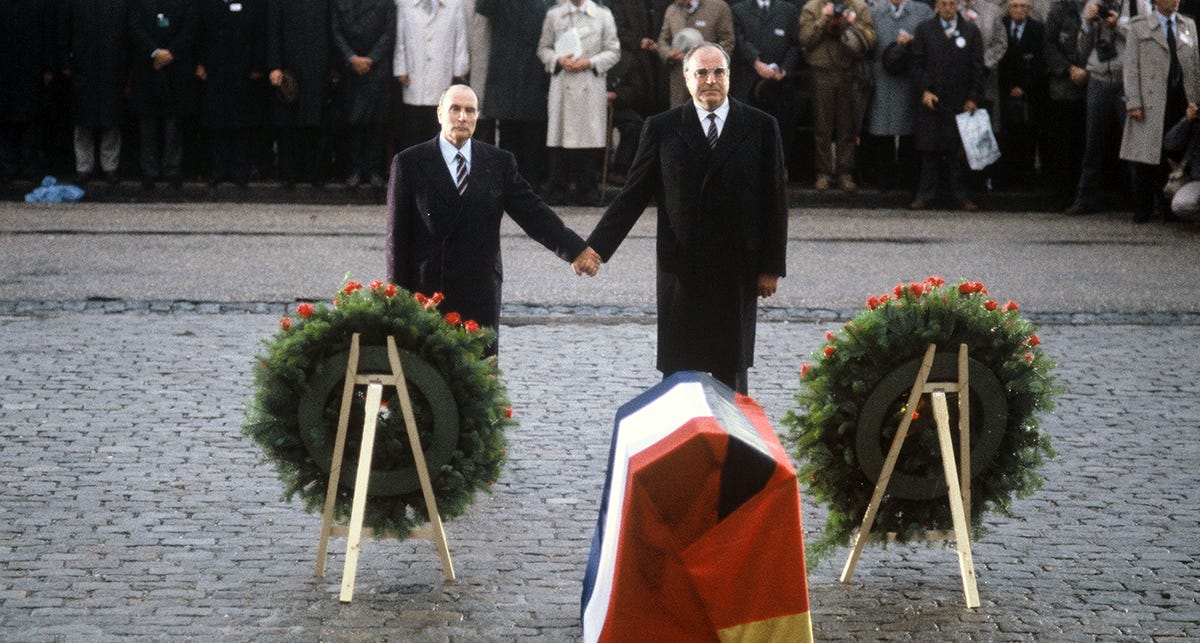
This is the starting point. For over four centuries, France’s strength threatened German security and vice versa, leading to a vicious cycle of recurring catastrophic conflict from the Thirty Years’ War to the two World Wars. The two waves of European Founders, from Konrad Adenauer in the 1950s to Helmut Kohl in the 1990s, sought to permanently break this cycle not only through symbolic reconciliation—psychological factors like good-feeling are rarely durable—but through institutional and socioeconomic lock-in.1
The European Founders achieved this lock-in through a series of Treaties entailing the nation-states’ legal commitment to submit to the decisions and lawmaking of supranational (effectively, federal) institutions, socialization of policymakers in shared decision-making processes, and the creation of shared economic interests and interdependence through a common market and currency. These measures were meant to make a reversion to traditional nation-state conflicts impossible.
The end of the Cold War signaled that peace in western Europe might no longer be secured by U.S. involvement and the shared threat of Soviet communism. In his December 1991 speech arguing for ratification of the Maastricht Treaty in the Bundestag, Kohl argued the treaty’s creation of a common currency would make European union “irreversible.” Despite the Eurozone’s problems, the popularity of the Euro among Europeans and, no doubt, the fear of uncertainty entailed by withdrawal from the Euro, suggest Kohl was very right on this point.
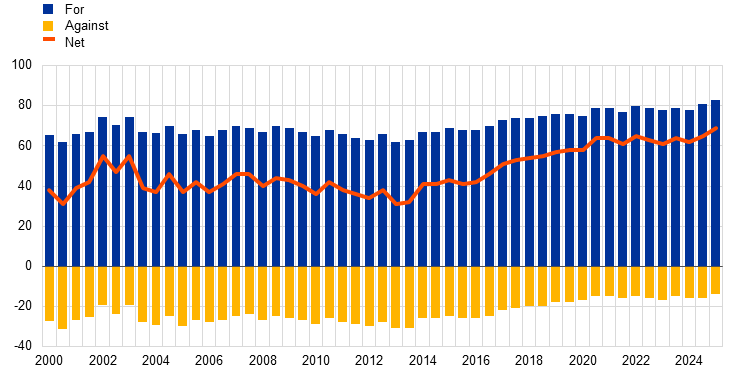
If even Greece’s far-left Syriza was unwilling to leave the Eurozone despite Depression-like conditions, it is unlikely other populist government will be willing to do so. Among Eurozone members, anti-EU agitation is likely to be largely symbolic and within bounds ensuring macroeconomic stability (hello Italy’s Prime Minister Georgia Meloni and France’s possible future president Jordan Bardella).
I used to be rather dismissive of the peace argument for the European Union. Our old, childless welfare democracies do not seem particularly belligerent. Even without the EU, would they even have it in them to resort to war among each other? In the age of Putin and Trump I am less dismissive. It takes only one foolish leader’s caprice to return to the usual vicious circle of mutual insecurity dynamics between neighboring nation-states. The European Union massively reduces the catastrophic downside risks of conflict among our nation-states, conflict which can only be deadly to our freedom and development.
2. The Common Market: A continental space of freedom
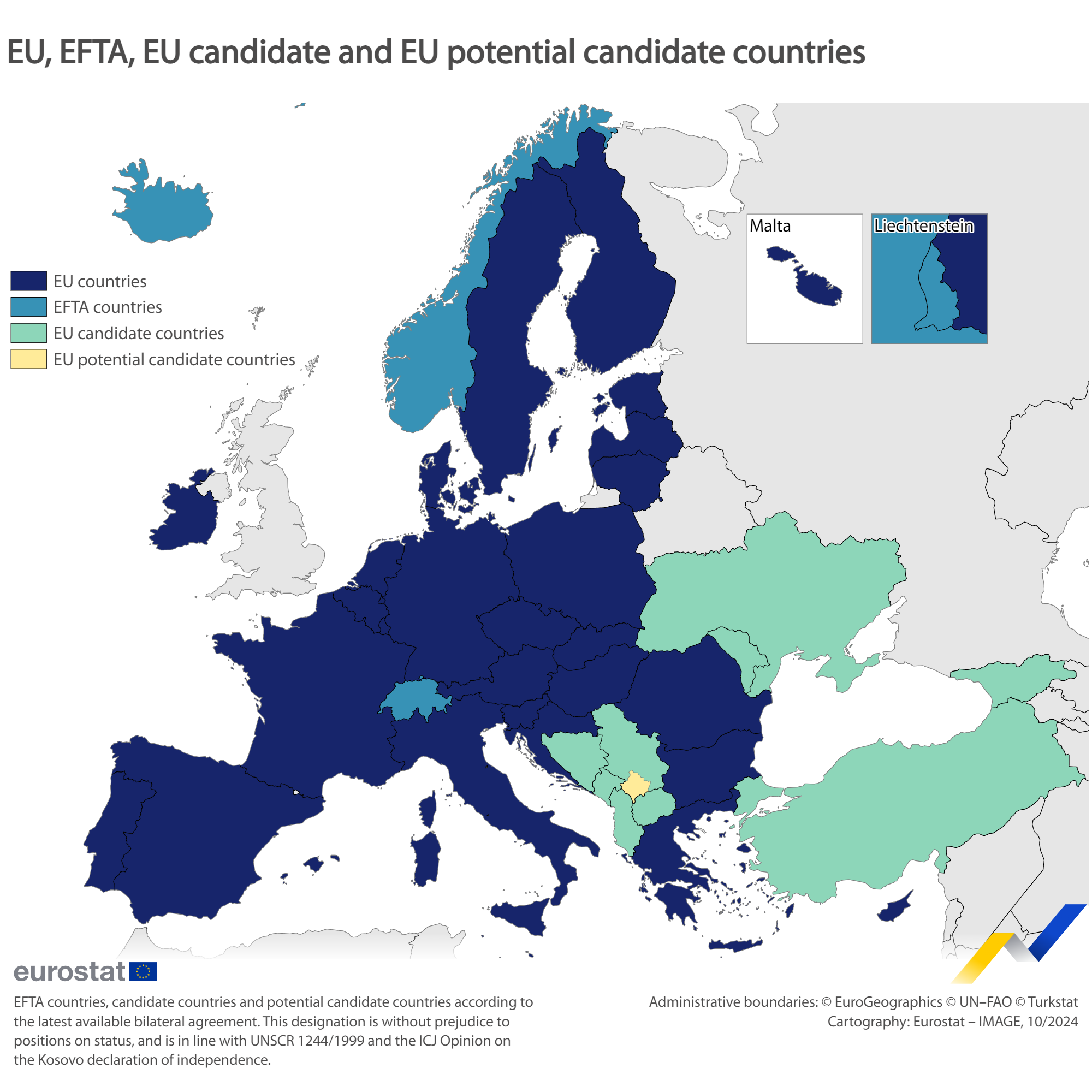
The European Union has created a a vast continental Common Market of 450 million people defined by Four Freedoms: free movement for goods, services, capital, and people. This is a remarkable achievement among 27 nation-states. Other regions have developed similar market-building efforts—ASEAN, Mercosur, the African Union’s Continental Free Trade Area, the Russian-led Eurasian Economic Union—but none is as deep and seamless as the European Common Market.
The Common Market represents tremendous convenience for companies and people in Europe. For EU citizens, you simply take for granted that you can study, live, and work in any other EU country without hassle or legal uncertainty. The Common Market is also a great antidote, albeit insufficient, to national welfare and regulatory states’ endogenous political dynamics towards economic stagnation and decline: individuals can leave to more prosperous and competitive countries, while monopolistic national companies have less scope for domestic market capture but must adapt to outside competition. People and capital can vote with their feet instead of being entrapped by centralized nation-states captured by special and generational interests.
The Common Market also naturally led to the European Union becoming a powerful trade bloc and regulatory regime, whereby Europeans can stabilize their geopolitical neighborhood via economic incentives and assert their preferences in the global economy. While the EU’s geopolitical clout is largely restricted to the commercial and regulatory domains, it is real. Most recently, President Trump backed down (TACOed) on his threats to impose tariffs to take over Greenland because the prospect of EU trade retaliation (the “trade bazooka”) tanked the stock market. The Common Market remains the fundamental achievement and core engine of European integration.
3. A pole of attraction and “convergence engine”
Finally, the European Union is a powerful pole of attraction for neighboring states—who desire to benefit from similar freedom, prosperity, stability, and good governance—and a “convergence engine” for new members. This is very apparent if we compare the economic trajectories of EU joiners (e.g., Poland, Romania, Bulgaria) and comparable non-joiners (Belarus, Ukraine, Moldova, Macedonia) in post-communist eastern Europe.
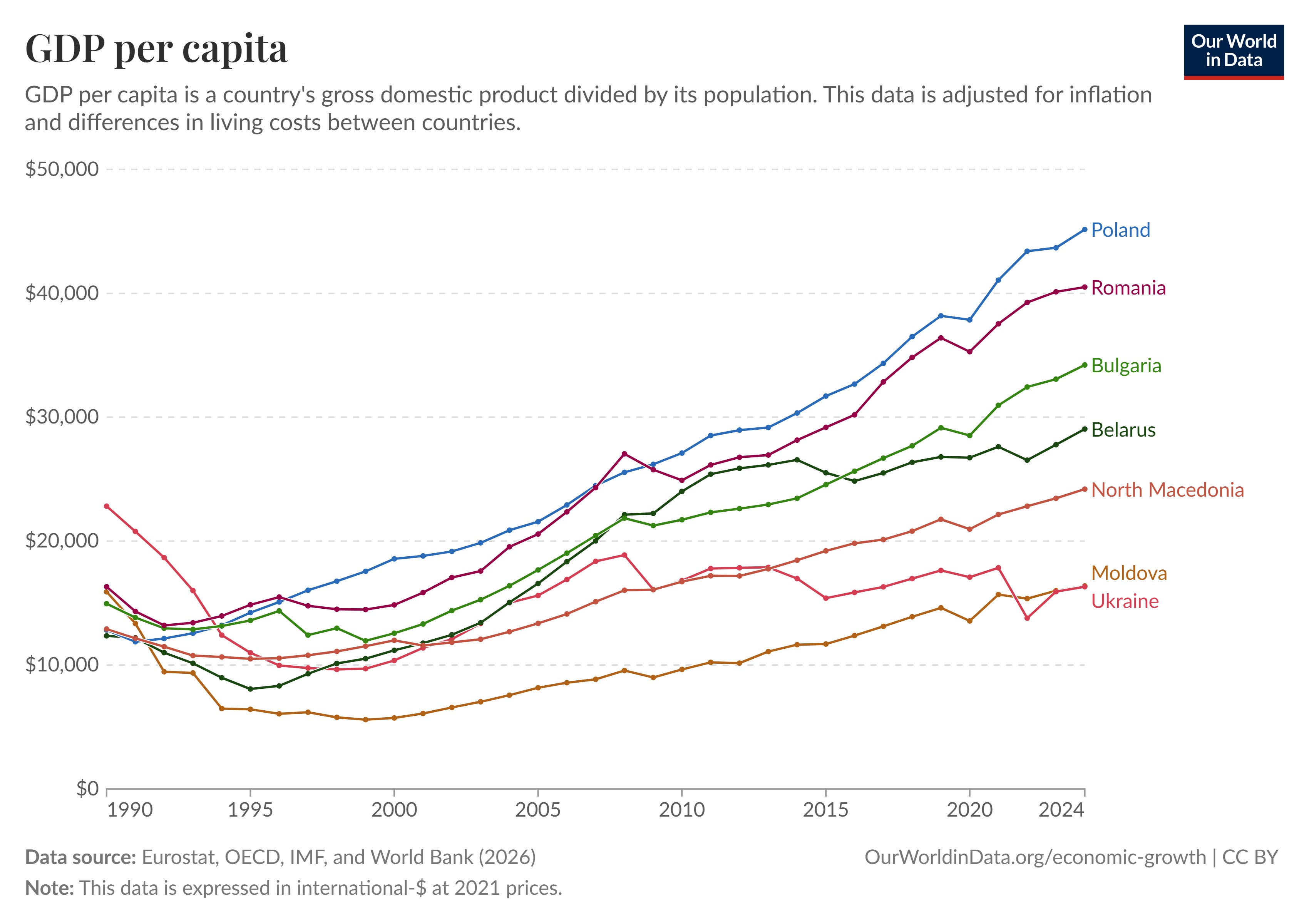
The divergences are clear. It is hard to believe that Poland—which has achieved almost west-European levels of wealth—was poorer than Ukraine only a generation ago. I think the economic success of EU joiners has been partly due to EU development funds, but probably moreso thanks to the signal that EU membership and market access sends to both national companies and international investors.
It is also apparent—though this fact is underappreciated by Westerners who take their functional institutions for granted—that many national (semi-)democracies have entrenched tendencies towards native corruption and incompetent governance that do not spontaneously resolve themselves. The incentives of EU membership evidently can decisively attenuate these, though full convergence to north-European standards (“getting to Denmark”) rarely occurs.
“A good place” to be
The European Union creates individual and collective capabilities for citizens and nations, but also serious constraints. Trade-offs are real and often, in the name of a kind of a dull culture of consensus, underdiscussed. This naturally leads to disengagement, alienation, and frustration among citizens. Not least, the Eurozone entails huge suprademocratic constraints on macroeconomic policymaking which were scarcely communicated to citizens.2
Perhaps most dangerously, the European Union has a tendency to empower governments, vis-à-vis their own societies, and to overregulation, notably due to national executives’ constant collaboration and lawmaking role in the Council. (European lawmaking is effectively bicameral, with a directly elected European Parliament and the Council of national goverments acting as a kind of senate.)
One must be able to recognize the European Union’s constraints and defects while also acknowledging its achievements. One can certainly conclude that one’s country would be best served outside the Union—and the right to secession is guaranteed by the Lisbon Treaty, the EU’s basic law—although the British seem to have learned otherwise from their experience of Brexit. So long as one is a member, one must be able to work with the European Union’s particular structure and dynamic to thrive as a nation. And one must articulate and work towards passing constructive proposals for reform, because every political entity is a continuous work-in-progress.
In an age of geopolitical chaos, the European Union’s considerable achievements are striking: a continental space of peace, freedom, and law among 27 nation-states. As President Macron virally said of Europe at this year’s World Economic Forum in Davos: “Sometimes it’s too slow, for sure, and needs to be reformed, for sure—but which is predictable, loyal, and where you know that the rule of the game is just the rule of law, it’s a good place.”
The European Founders’ arguments were remarkably similar to the American Founders on this point. Cf. in particular Alexander Hamilton’s early essays in the Federalist Papers highlighting insecurity and conflict among neighboring states as a prime cause of authoritarianism and lawlessness in Europe, and potentially North America, and making the case for federalism as the key to eliminating said insecurity and conflict.
The Eurozone both transfers monetary policymaking to an independent European Central Bank (ECB) meant to be wholly insulated from democratic politics and entails a system of “monetary dominance,” whereby the goal of limiting inflation takes precedence over fiscal policymaking, meaning democratic policymaking is supposed to be constrained by deficit limits. Critics of majoritarianism—those who prefer law and liberty to day-to-day majority rule by elected parliaments—may see these characteristics of the Eurozone as virtues: after all, elected politicians, following well-known incentives, will tend to promise the people money the state does not have, leading to inflation and unsustainable deficits. West-European nation-states’ ongoing and permanent fiscal crises—driven by constantly-rising pension and healthcare costs amid an aging population and fertility collapse—is the rotten fruit of this humane demagogy.
What happens when it collapses?