

Welcome to the latest issue of Repronews! As you may have guessed, my capacity to produce this newsletter has fallen in recent months. I could not resist producing another issue given a few a major new stories however. Enjoy!
Highlights from this week’s edition:
Repro/genetics
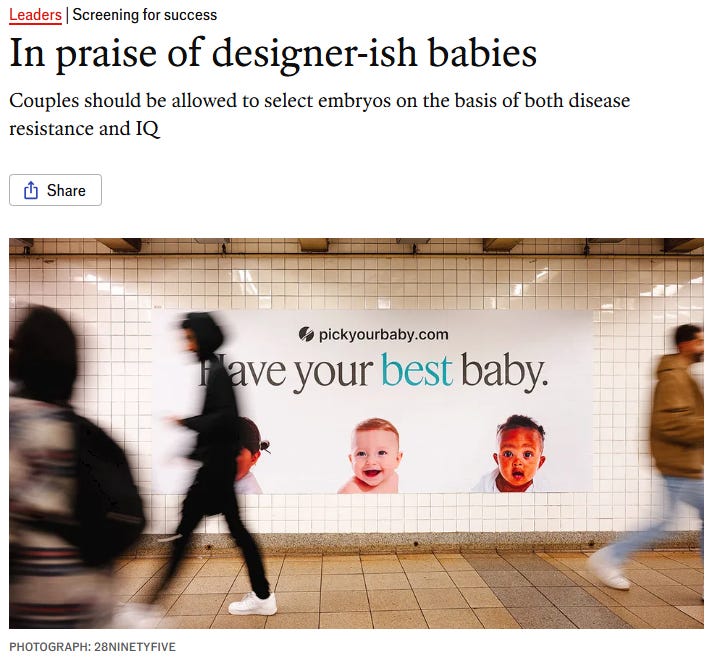
The Economist endorses polygenic embryo selection for health and enhancement, including IQ. The liberal magazine argues current limitations and uncertainties of the technology “are an argument for disclosure, however, rather than legal restrictions or outright bans.”
An ESHRE/PET survey of four European countries has found majority support for state-funded fertility treatment and significant support for gene editing to prevent serious diseases.
A high-level British government report argues for developing “regulatory readiness” to evaluate in vitro gametogenesis (IVG) before the technology becomes viable.
Researchers are trying to use gene editing to silence the extra chromosome in embryos which may develop Down’s syndrome, potentially preventing the condition.
Population Policies & Trends
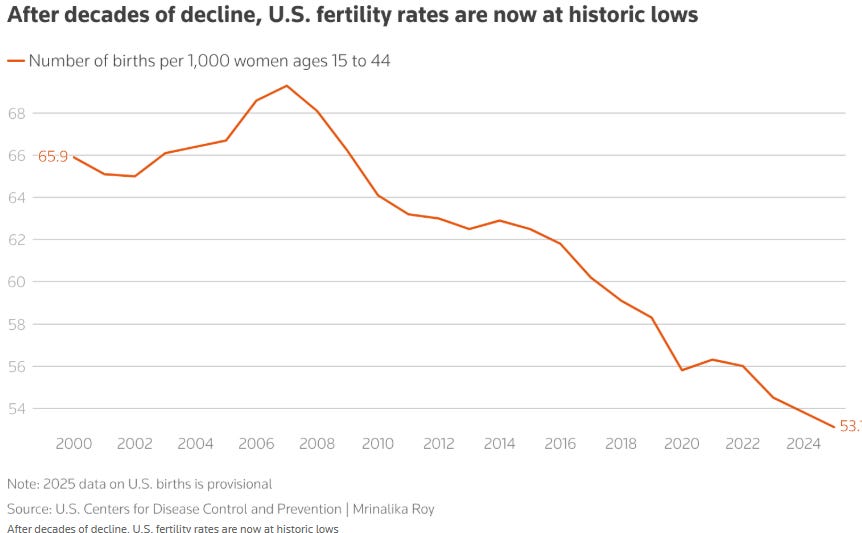
U.S. fertility rate fell to record low in 2025.
The Financial Times writes on falling fertility in the Nordic countries despite family-friendly politics.
China integrates pronatalism in its 2026-2030 Five-Year Plan, aiming to create a “childbirth-friendly society.”
The Financial Times’s John Burn-Murdoch argues fertility is simultaneously falling worldwide due to access to smartphones.
Genetic Studies
Harvard’s Reich Lab analyzes 16,000 ancient genomes, revealing accelerated human evolution since the advent of farming and natural selection affecting hundreds of genes in West Eurasia.
Repro/genetics
“In defense of designer-ish babies” (The Economist)
The Economist writes that couples “should be allowed to select embryos on the basis of both disease resistance and IQ” through polygenic selection.
Silicon Valley startups are offering polygenic embryo screening alongside IVF to select embryos with lower genetic risk of diseases (such as certain cancers, diabetes, and schizophrenia) and higher likelihood of developing traits such as IQ.
The Economist argues there are “kernels of truth” to arguments that the technology is immature or immoral, but concludes that “[b]anning or heavily restricting embryo screening would be a mistake.”
“For now, the debate is a niche concern. The startups mostly cater to the rich, famous, and odd. Yet that will change. A wave of investment means that the cost of IVF is likely to fall. If offered embryo screening at the same time, many couples will take it. One survey suggests that three-quarters of Americans support screening embryos for diseases; about a third say the same for non-disease traits.”
The Economist argues that the complexity of polygenic scores, their higher accuracy among people of European ancestry, and possible current low effectiveness “are an argument for disclosure, however, rather than legal restrictions or outright bans.”
A 2019 study found that parents choosing from among 10 embryos could boost IQ by 1 to 7 points; effectiveness has likely increased since as polygenic scoring improves with growing genetic databases with broader population coverage and more effective AI tools linking genes to phenotypic traits.
“[T]here is a big difference between the murderous coercion of early-20th-century eugenics programmes and parents seeking as much knowledge as possible when picking an embryo. Couples desperate for a clever child might be better advised to focus on what happens after birth. Yet so long as parents understand there is no such thing as the perfect baby, the state should not stand in the way of a bit more information.”
A separate article goes into more detail on reprotech startups like Nucleus, Orchid, and Herasight, and the progress and limitations of emerging reprotech interventions.
Economist Podcasts+ spoke with Herasight’s Jonathan Anomaly and Draper’s Michelle Kwok on reprotech startups and polygenic selection.
European survey: broad support for fertility care, embryo research and genome editing (EurekAlert!)
A survey by PET and ESHRE, Britain and Europe’s leading fertility associations, explored public attitudes to reprotech and embryo research in Britain, the Netherlands, Spain, and Italy.
In all countries, most respondents supported state-funded fertility treatment for people experiencing infertility (from 54% in the Netherlands to 64% in Italy).
Supporters of embryo research outnumbered opponents in all countries, including Italy, where research on human embryos is banned.
Most people in Britain, the Netherlands, and Spain supported genome editing to eliminate severe or life-threatening conditions. The practice is currently illegal in all four surveyed countries.
ESHRE’s Professor Karen Sermon said: “It is particularly striking that support for some applications extends beyond what is currently permitted in certain countries. As science advances, it is essential that public awareness keeps pace, so that decisions about future treatments are informed by both evidence and societal values.”
Sarah Norcross, director of PET, said: “There are some surprising findings, such as younger respondents in all four countries being more likely than older respondents to say that sex selection should be permitted. It is also striking that in each of the four countries, the number of respondents saying that surrogacy should be permitted exceeds the number who say that surrogacy should be prohibited.”
“Modernising regulatory pathways for assisted reproductive technologies: A case study on in vitro gametogenesis” (UK Government)
A high-level report by Britain’s Department for Science, Innovation & Technology, Regulatory Innovation Office, and Regulatory Horizons Council argues the country must already develop “regulatory readiness” to evaluate in vitro gametogenesis (IVG) before the technology becomes viable.
IVG involves the creation of sperm or ovaries in the lab, usually by transforming other human cells.
Lord David Willetts, chair of the Regulatory Innovation Office, writes that the report “sets out, seriously and in one place, the choices the UK will face as IVG and related technologies develop: how we assess it, how we govern it, and how we maintain the public confidence on which progress in assisted reproduction has always depended. The central question is not whether change will come. It is whether we are ready when it does.”
The report warns that waiting carries strategic costs in terms of lost British research, investment, and talent; greater fertility tourism abroad; dependence on foreign safety evidence; and reduced ability to shape international standards.
The report notes IVG could enhance polygenic embryo selection by enabling many more eggs/embryos to be created and selected from. IVG could also enable same-sex couples to have fully genetically related children.
“Researchers eye potential Down syndrome fix via advanced gene editing” (Reuters)
Researchers at Beth Israel Deaconess Medical Center in Boston have developed a modified version of CRISPR gene editing with the the potential to “silence” the extra chromosome that causes Down syndrome.
People with Down syndrome are born with an extra copy of chromosome 21.
In healthy human females, a gene called XIST naturally silences the extra X chromosome that is present in all female cells except eggs.
Scientists are attempting to silence the extra chromosome 21 by inserting XIST. Challenges include insert the gene in only one of a cell’s three copies of chromosome 21 and achieving this in as many of an embryo’s cells as possible.
More on repro/genetics:
“Trump administration moves to make fertility benefits easier to access” (Washington Post)
Population Policies & Trends
“U.S. fertility rates drop to record low in 2025 as births fall” (Reuters)
The U.S. fertility rate hit a record low last year, extending a nearly two-decade decline, according to provisional data from the U.S. CDC.
The number of babies born in the U.S. in 2025 fell 1% from 2024 to roughly 3.6 million. The general fertility rate (the number of births per 1,000 women aged 15-44) also fell 1% to 53.1.
The U.S. general fertility rate has fallen nearly 23% since 2007.
Fertility rates among women in their 30s and 40s have increased over the past decade, but those gains have been too small to offset declines among women under 30.
In 2025, the fertility rate among women aged 25-29 fell 4.4%, while the rate for women aged 30 to 34 rose about 2.7% from 2024.
Fertility rates among teenagers declined sharply, with the rate for those aged 18-19 falling 7% and the rate for teens aged 15-17 dropping 11%, record lows.
“Nordic fertility support measures are not working” (Financial Times)
The Nordic countries have among the world’s most family-friendly policies, but fertility rates are falling well below replacement level.
In 2024, fertility rates ranged from 1.25 children per woman in Finland to 1.91 in the Faroe Islands.
Since 2010, fertility rates have fallen 19% in Greenland and 33% in Finland.
Fertility rates are falling especially among people under 30 and less educated people.
The share of people saying they want two to three children was stable between between 1970 and 2021.
“China integrates pronatalism into Five-Year Plan” (Reuters)
China’s Five-Year Plan for 2026-2030, presented in March, aims to create a “childbirth-friendly society.”
Related measures include “promoting high-quality, full employment, improving the income distribution system, and refining the social security system,” as well as stronger housing support and fostering “positive attitudes towards marriage and childbearing.”
China’s population fell for a fourth year in a row in 2025.
Measures currently being implemented include a national child subsidy and reimbursement of IVF and other pregnancy-related expenses.
By 2035, China will have over 400 million people over 60.
“Why birth rates are falling everywhere all at once” (Financial Times)
John Burn-Murdoch, the FT’s chief data reporter, argues smartphones and digital media have accelerated fertility decline by reducing face-to-face socializing and romantic coupling.
Fertility downturns repeatedly coincide with local smartphone adoption.
Fertility decline is accelerating worldwide: over two-thirds of countries are now below replacement fertility, including many lower- and middle-income countries (LMICs).
The fall is faster than demographers expected. South Korea’s 2023 births were about 50% below a UN forecast made only five years earlier.
The core problem increasingly appears to be fewer people forming couples and becoming parents, rather than parents having fewer children.
Most young people still say they want roughly two children, creating a substantial gap between desired and achieved fertility.
Housing insecurity possibly explains up to half of the fertility decline since the 1990s in the U.S. and Britain, but cannot fully explain the recent global acceleration.
Social media may raise relationship expectations, intensify gender and ideological divisions, increase anxiety, and weaken committed relationships, especially among less-educated young adults.
Burn-Murdoch concludes: “The bigger point is that falling birth rates appear to be part of a broader phenomenon of young adult singledom, isolation and deteriorating wellbeing. Given the likely link to technology and social media, the best hope of reversing the trend may be to change our digital habits—whether through cultural shifts or government regulation.”
More on population policies and trends:
“The West’s demographic math no longer adds up: An intergenerational bargain that boosted prosperity is falling apart” (Politico)
“Births in England and Wales fall to lowest level since 1977” (Financial Times)
“Declining birth rates and population ageing: Impact and government response” (House of Lords Library)
“Can stimulating ownership increase fertility: Evidence from housing interventions in China” (PNAS)
“Modi allies push for bigger families despite India’s 1.4-billion population” (Reuters)
Genetic Studies

“Massive ancient-DNA study reveals natural selection has accelerated recent human evolution” (Harvard Medical School)
Analysis of nearly 16,000 ancient genomes reveals natural selection has acted on hundreds of genes in West Eurasia over the last 10,000 years.
The study effectively doubles the number of ancient genomes researchers can draw from.
More than half of the genes have known links to disease risk and other traits, such as risk of type 2 diabetes and schizophrenia.
Previous studies of ancient human DNA identified only around 21 instances of directional selection (natural selection when a version of a gene is so advantageous for survival and reproduction that it rapidly spreads in a population).
The new analysis shows directional selection has driven the spread or decline of hundreds of gene variants in West Eurasia since the end of the Ice Age. Selection has accelerated since the transition from hunter-gathering to farming.
DNA variants that were identified as being historically selected include ones associated with light skin tone, red hair, risk of celiac disease and Crohn’s disease, immunity to HIV infection and resistance to leprosy, lower chance of male-pattern baldness, and lower risk of rheumatoid arthritis and alcoholism.
Genes associated today with polygenic traits were also identified as being under selection, including intelligence, reduced risk of bipolar disorder and schizophrenia, and lower body fat percentage, waist-to-hip ratio, and body mass index.
However, the researchers warn that a given gene’s current associations do not necessarily tells us why it was selected for in the (pre)historic environment, given the degree to which our environment has changed.
More on genetic studies:
“A global map for introgressed structural variation and selection in humans” (Science)
“Analysis of 173,303 exomes and genomes in the Pakistan Genome Resource” (Nature)
Disclaimer: We cannot fact-check the linked-to stories and studies, nor do the views expressed necessarily reflect our own.