

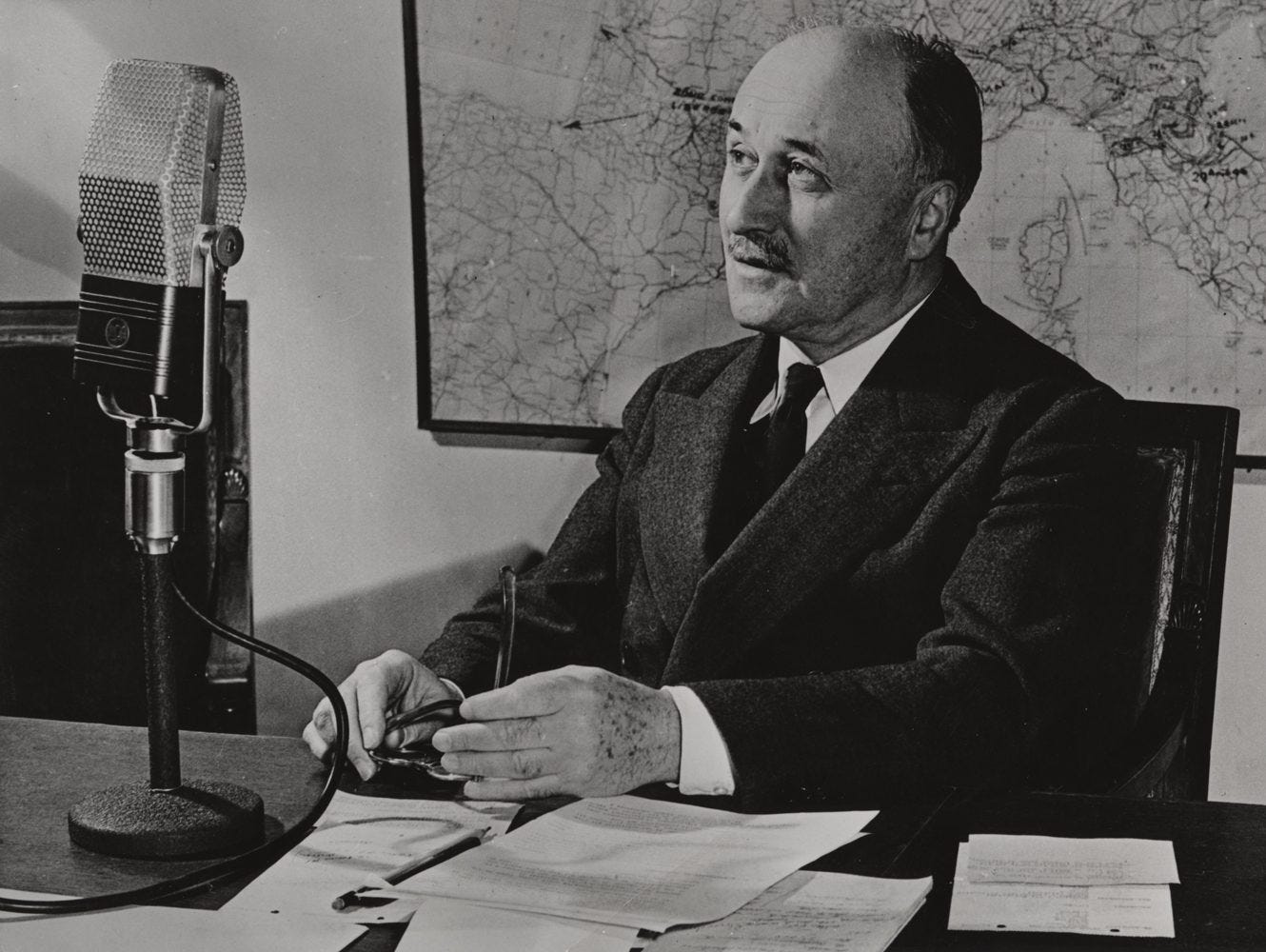
Jean Monnet and Robert Schuman are without doubt the two most frequently referenced European Founding Fathers. I tend to think the two are overemphasized.1 Yes, on the French side, they were instrumental in proposing the principle of supranationalism—of a federal-style binding legal authority and power above the nation-states. Without France, nothing could happen. They implemented this with European Coal and Steel Community (ECSC), creating a common regulated market for those two sectors. They tried to do the same with the European Defence Community (EDC), which would have created a European Army, but failed. And that’s about it. Neither Monnet nor Schuman had much of a role in setting up the European Economic Community (EEC) and the Common Market, the core engine of European union.
Monnet allegedly had a “method” for achieving European federation through small integrative steps leading to unification through spillover (enlisting business interests, creating confidence and mutual understanding through cooperation between national officials, creation of common interests through interdependence…). While there is some truth to this, I think this is partly post hoc rationalization.
If Monnet had a method, it was a remarkable one of career development and institutional entrepreneurship. This method entails three simple steps:
Find a current issue which requires transnational action.
Find and convince the relevant decision-maker to set up a body to take said action.
Get appointed to said body.
Monnet did this at least three times. In 1914, aged just 25, he managed to meet French Prime Minister René Viviani through a family friend and stressed the need for Anglo-French coordination of economic resources. He was sent to London to work on that and helped create the Allied Maritime Transport Council in 1917. In 1939, Monnet again pushed for Anglo-French coordination of war supplies, but this time was put in charge of the relevant committee. In 1950, Monnet masterminded the proposal to pool European coal and steel markets, leading to his appointment two years later as President of the newly-created ECSC. Also in 1950, he was the one within the French administration to propose the creation of a European Army.
These are remarkable achievements. Not least if you consider that Monnet had not even graduated high school, which means the first President of a European Community would not have been eligible to be hired by today’s EU institutions, which require a college degree. Monnet was worldly, proactive, and practical. As a salesman for the family cognac business, he had traveled in the United States and the British Empire, and been much impressed by the expansiveness and growth mindset of the Anglo world, contrasting with the “Malthusian” (parochial and zero-sum thinking) common in France.
I am not sure Monnet had much of a specifically European thought, or really anything like sustained theoretical thought, beyond his technique of pushing for transnational governing bodies. In 1940, during the Fall of France to the Nazis, Monnet also proposed a “fusion” of the British and French nations—with one citizenship, one army, one parliament, and one cabinet. This was not a matter of “small steps.” The British government actually took this up and made a proposal of Anglo-French Union. Astonishingly, even the French arch-nationalist Charles de Gaulle backed the idea.
For the British and the Gaullists, this was really about salvaging as many French resources as possible for the war effort and not letting the French Navy and colonial empire fall under Nazi control. Monnet later claimed the “fusion” was meant to be permanent (which no doubt de Gaulle would have found appalling, though he commented little on the proposal). Monnet says nothing on how such a binational state would work, just as there is little on how the Six ECSC states would gradually federate.
Really, Monnet just liked transnational governance. He seems to have been much more interested in the world, with Europe being a mere vehicle. He also seems to have been bored as President of the ECSC and left office early to become a fulltime adovcate of European federalism. Anyway, Monnet made some real contributions while advancing himself effectively: Create your own job, suited to your own skills and temperament, by identifying a real need and pitching it to the relevant decision-maker. Good stuff!
It seems to me the single most important figure in the creation of the European Communities is West-German Chancellor Konrad Adenauer. From the immediate postwar years (even before his appointment as Chancellor) to his leaving office in 1963, he was the most consistent and influential supporter of European unification. He made bold proposals which were often rejected, but he was not discouraged. He let the French claim credit for European initiatives. He supported European unity beyond what was necessary to restore West-German sovereignty and wanted Europe to consolidate as a power bloc, allied with the United States but capable of autonomy. Other figures arguably as important as Monnet and Schuman are those who created the European Economic Community and Common Market. These include the Netherlands’ Johan Beyen (who pushed for a whole Common Market rather sectoral integration after the failure of the proposed European Army), Belgium’s Paul-Henri Spaak (who skillfully chaired negotiations reaching necessary agreement on the Common Market), and Walter Hallstein (the first President of the European Commission and as a lawyer the most theoretically explicit and rigorous of the European Founders).
I think this may be underappreciating Monnet's method. Yes, it is often described as doing small steps where large steps are politically impossible, but there's more to it. For each of those steps, a recurring pattern seems to be applied: At the beginning, there's no political will to do the step. Never mind, network will all the stakeholders, so that you have access once needed. Wait for a crisis that makes the step necessary, or at least palatable. Propose the solution. If it does not work, wait and try again during the next crisis. Rinse and repeat with each small step.