

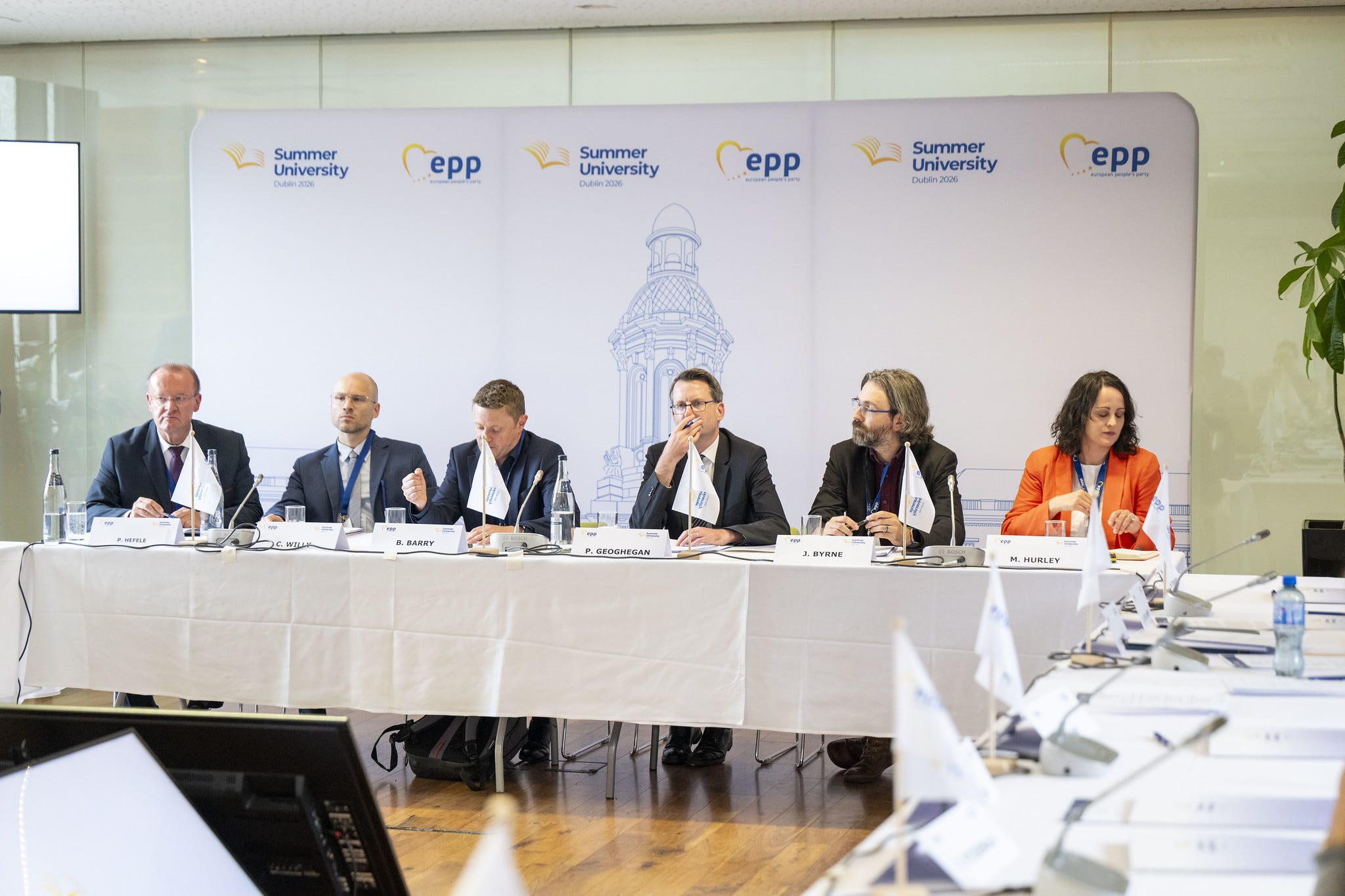
I had the privilege to be invited to contribute to a panel discussion at the European People’s Party’s (EPP) first “Summer University” at Trinity College Dublin earlier this month. In continental parlance, a summer university is a get-together of party officials, supporters, and academics for lectures, debates, and trainings. The center-right EPP has long been the biggest political grouping in the European Parliament.
Participants included EPP Secretary General and Member of the European Parliament (MEP) Dolors Montserrat (Spain), Ireland’s former European Commissioner Mairead McGuinness (who during her term of office pushed the concept of Open Strategic Autonomy), many other current and former officials from across Europe, and a range of high-level Irish academics.
Our panel was dedicated to how policymakers and academics can support Europe’s strategic goals. Here is the gist of my talk:
Firstly, Europeans must think more in strategic terms. The days when Europe could have the luxury of being impotent-but-comfortable are over. Economic decline, China’s rise, Russia’s aggression, and the Trump administration’s capriciousness and hostility all mean Europe must maximize its economic, technological, and geopolitical capabilities. To be strategic means to think about and act to develop these capabilities, recognizing the interdependencies and trade-offs across different policy areas.
The most basic strategic capability is economic. Europe needs to GDP-max (I am happy to say this line got some applause from the audience). In a time when many pooh-pooh the relevance of economic growth or even advocate degrowth, we need to recall that most everything depends on GDP: sustaining the EU’s global economic clout and trade power, managing rising pension and healthcare costs, remilitarization to protect against Russia, foreign aid to plug the gap left by MAGA, financing R&D to discover the innovations to overcome environmental, health, and other challenges—all these things depend on GDP growth. Once equal to the U.S., EU GDP is now one third less. Eurodecline is real, sadly. There is every reason to think growing U.S. economic and technological superiority is in large part due to far greater possibilities and incentives for high-risk, right-reward investments, notably due to deeper capital markets, lower taxes, cheaper energy, more flexible labor, and a growing unified market itself. As such, Europe must implement pro-competitiveness reforms in line with the Draghi report.
Secondly, I don’t think European academia should be drafted wholesale into any political agenda, whether economic, strategic, or otherwise. Academic freedom is crucial. So is pure curiosity-driven basic research. Who would have thought investigating bacterial immune systems would lead America’s Jennifer Doudna and France’s Emmanuelle Charpentier to develop precision gene-editing? Or that studying the venom of the gila monster, a North-American lizard, would lead to the development of GLP-1 weight loss drugs, which are now having a huge impact against diabetes and obesity worldwide? It is legitimate for policymakers to require that taxpayer-funded research provide some public benefit—or at least have some plausible if usually unpredictable possibility of doing so—but I am wary of imposing more bureaucratic requirements and tick-box exercises on researchers. Indeed, some of the academics present shared negative experiences about very onerous reporting requirements for some EU projects taking up a huge amount of time.
Thirdly, policymakers and researchers need to think about how academia can support Europe’s strategic goals in specific and bounded ways that don’t compromise academic freedom or waste taxpayer money. I already made a few suggestions in this direction in my paper for the Martens Centre, the EPP’s think tank, on how EU Horizon research funding can support competitiveness. Some ideas on how academia can legitimately support European strategic goals:
Allow EU Horizon funding to finance dual-use technologies that can have both military and civilian purposes (e.g., AI, drones). This has been sensitive in the past due to the pacifist / neutralist traditions of some EU countries.
Foster European universities’ and research alliances’ attractiveness to researchers worldwide (relevant given recent U.S. policies weakening that country’s traditional brain gain). In a world of geopolitical predators, Maintaining Europe’s reliability as a place for academic openness and international research collaboration is a great source of soft power.
One area I have not seen sufficiently discussed is how the EU can leverage its universities and broader attractiveness to brain and labor drain hostile states. Wages and quality of life in the EU are greatly superior for both researchers and workers than in countries like Russia or Belarus. While being mindful of security concerns, willing EU countries should attract defectors, researchers, draft-dodging youth, and other human capital. This can both strengthen EU countries and weaken hostile states, which already face their own demographic challenges.
Create timebound EU-funded university alliances to work on specific challenges to cross-border research. Such alliances could develop for example scalable models for mutual recognition of qualifications, standards to pool Europe’s rich but fragmented stores of data, and infrastructure for use by both fee-paying businesses and academic research. These alliances must not become permanently taxpayer-funded mini-EU bureaucracies.
Expand the Horizon program’s collaboration with other scientifically advanced middle powers (e.g., Great Britain, Canada, Japan, South Korea, Singapore…). One promising area is developing an AI cyberdefence coalition among the EU and middle powers. While currently no other countries are competitive with the U.S. and China on frontier AI, a coalition of countries with a shared interest in a stable, rules-based international order could effectively work together to develop infrastructure against AI threats, including state threats.
I cannot do justice to the various interventions from the other participants. I would highlight however:
My co-panelist Dr. Brian Barry provided insight into how in Ireland academics and randomly selected citizen assemblies co-create the specifics of referendum proposals. This remarkable model was notably used in Irish referenda on presidential terms of office, gay marriage, and abortion legalization.
Professor Patrick Geoghegan, one of the country’s leading political historians, spoke on the rise of political intolerance Irish universities, much of it, it must be said, driven by students (e.g., members of the country’s oldest student union boycotted The Irish Times, Ireland’s newspaper of record, for being “anti-trans.”)
Excellent interventions from the Martens Centre’s Dimitar Lilkov on the EU’s underperformance in AI/tech and Dr. Federico Ottavio Reho on the dangers of overly broad interpretations of EU values (i.e., judiciaries equating these with the latest brand of progressivism, rather than focusing on maintaining the rule of law).
Overall, the gathering made it clear to me that many European leaders and think tankers are perfectly cognizant of the challenges facing Europe and are working to overcome them. Europe’s challenges are formidable—many of them seemingly intractable due to dysfunctional national political dynamics and an EU-level tendency to overregulation— but we shouldn’t forget the continent’s assets either. Over the long run, I am convinced that political communities defined by lawful cooperation tend to overcome those defined by arbitrary coercion.
A valuable intervention, Craig. Academic freedom is not a luxury. It is itself a strategic asset, allowing societies to discover what they did not yet know to seek.
I would add one question for the European centre-right: growth and capability in defence of GDP, capital markets, energy and research -all indispensable means. But political communities also require a shared sense of purpose, an understanding of what they wish to preserve, transmit and make possible for the next generation.
Europe must recover both capacity to act, and a persuasive account of why.